On November 18, the international all-science academic publisher Cell Press announced the winners of the "2024 Best Paper Award for Chinese Scientists." A research paper titled "A combined deep learning framework for mammalian m6A site prediction," published in Cell Genomics in 2024 by the team of Professor Cui Qinghua from WHSU's College of Sports Medicine, won the Cell Press award in the Interdisciplinary Science category. This marks the first time an expert from a Chinese sports university has claimed this prestigious award.
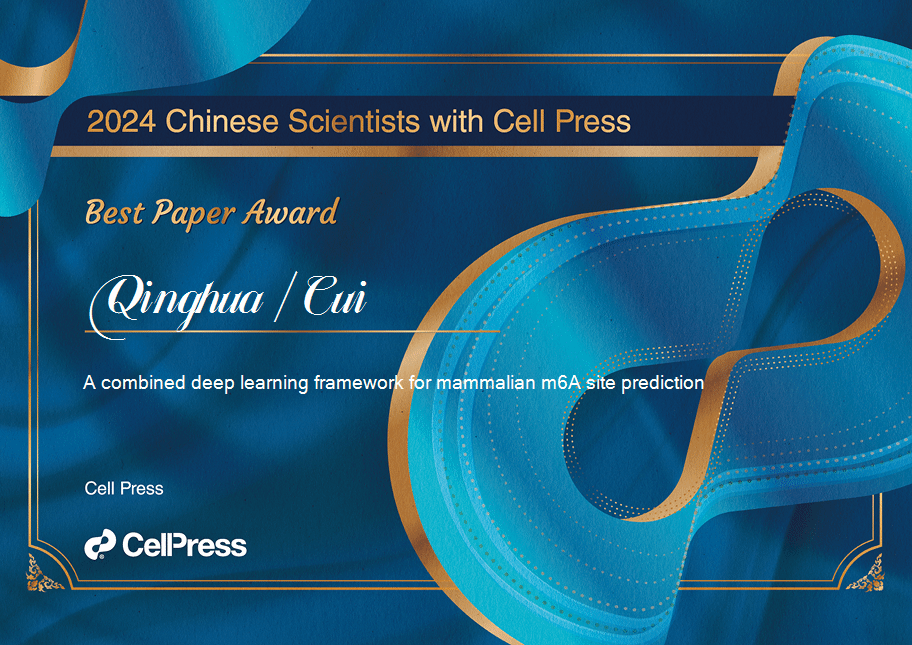
Cell Press, a premier global publisher in the scientific domain, has been presenting the "Best Paper Award for Chinese Scientists" for a decade, establishing it as a crucial metric for evaluating the international impact of Chinese research achievements. This award focuses on research papers published in Cell Press journals with a Chinese institution as the primary affiliation, covering five major fields: life sciences, physical sciences, medicine, interdisciplinary science, and sustainability. For the 2024 selection, a total of 2,446 high-level papers nationwide were considered. Following nominations by the Cell Press editorial team, independent review by a third-party expert committee, and a comprehensive assessment of metrics such as paper downloads, citations, and innovation and breakthrough potential within the respective fields, 10 papers were finally selected for the "Best Paper Award for Chinese Scientists" in each of the five categories, totaling 50 papers.

Prof. Cui's team's research stood out from numerous candidates due to its significant technical innovation, interdisciplinary integration, and application value, fully demonstrating the study's academic rigor and international recognition. The team introduced a combined deep learning algorithm that integrates a Transformer neural network and a Recurrent Neural Network (RNN) to achieve high-accuracy, cross-species prediction of m6A modification sites, which has been widely adopted by scholars both domestically and internationally.